
DDR5 Retail Dipped Briefly — But the Aftermarket Signal Never Wavered
By DRAM Resource Editorial Staff
When DDR5 retail prices pulled back in March, commentary defaulted to correction narratives. The secondary market told a different story — and it was less dramatic, more instructive.
The March Retail Noise
Retail DDR5 spot prices logged a meaningful pullback during the final weeks of Q1 2026, driven by a confluence of softening consumer PC demand and excess channel inventory flushed by distributors ahead of a traditionally weak spring selling season. The move was real, but its framing as a structural correction misread the underlying supply dynamics. Retail channels absorb consumer-grade, off-contract inventory; they are the most sentiment-driven, least signal-rich layer of the DRAM stack.
Institutional buyers have long known that retail tick-down events often coincide with tightening on the module grades that actually matter — ECC, RDIMM, and high-density DDR5 in server configurations.
What the Aftermarket Pulse Actually Showed
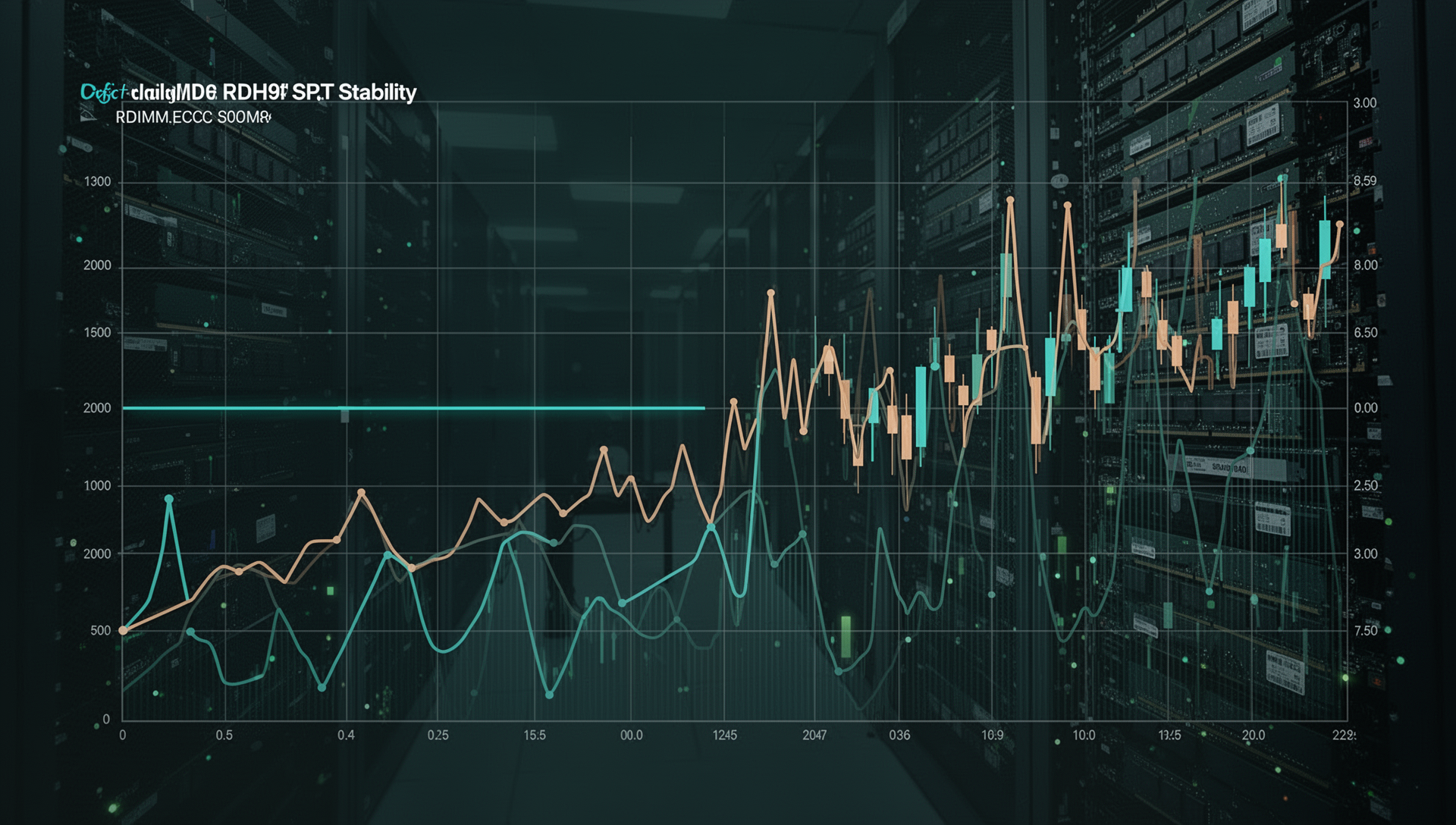
Through the same window, secondary-market pricing for enterprise DDR5 remained notably stable. DRAM Market Pulse readings across RDIMM and LRDIMM grades held within a narrow band, with no material erosion in bid-ask spreads on the volumes that move through ITAD channels, broker desks, and corporate refresh programs.
This matters for corporate buyers and ITAD operators planning procurement or liquidation: the aftermarket isn't a lagging echo of retail. In the DDR5 cycle, it has increasingly led — or at minimum, filtered out — the noise retail generates.
Spot-New vs. Secondary: A Study in Divergence
The broader context is harder to ignore. New-contract DDR5 pricing remains positioned hundreds of percent above mid-2025 spot levels, a consequence of supply discipline exercised by the major fabs through the back half of last year and sustained demand from AI-adjacent server builds. That premium hasn't collapsed; it compressed temporarily at the consumer tier and bounced.
The DRAM Pulse Report captures this divergence systematically — tracking secondary bids against new-contract averages across density grades and form factors. The spread data shows that aftermarket efficiency has improved even as spot-new prices remain structurally elevated. Secondary modules are clearing at values that reflect their workload utility, not a retail markdown.
Why Retail Metrics Mislead Institutional Buyers
Retail DRAM indices are consumer-grade, spot-weighted, and built around volume tiers that don't represent enterprise purchasing. When those indices dip, the signal is primarily about consumer PC sentiment, distributor destocking, and e-commerce promotional cycles — not about the grade or density composition that corporate IT and ITAD operators actually transact.
Following retail pricing as a proxy for aftermarket value consistently introduces lag and directional errors. A pullback in 8 GB DDR5 consumer kits has negligible predictive value for 64 GB RDIMM lots moving through decommission pipelines.
The Pulse as the Steadier Signal
For organizations making buy/hold/liquidate decisions on DDR5 inventory, the aftermarket bid curve — not the retail headline — is the operative data point. The DRAM Market Pulse tool is calibrated to that curve: drawing from secondary-market transaction data, broker feeds, and ITAD disposition volumes to surface the prices that institutional participants actually see.
The March retail dip was real. The aftermarket shrug that followed it was equally real — and considerably more informative. When retail flinches, check what the secondary market is doing. More often than not, the Pulse won't even register the tremor.
For ongoing market intelligence on DDR5 and legacy DRAM grades, see Industry Analysis and Industry News at DRAM Resource.
References
- DDR5 Retail Prices Pullback Amid Market Correction, But Industry Players Cite Stable Contract Trends — https://www.trendforce.com/news/2026/03/31/news-ddr5-retail-prices-pullback-amid-market-correction-but-industry-players-cite-stable-contract-trends/
- DRAM Market Pulse Tool — https://dramresource.com/dram-pulse/dram-market-pulse-tool
- DRAM Pulse Report — https://dramresource.com/dram-pulse/report
Questions or comments? We'd love to hear from you — reach the editorial team at info@dramresource.com.