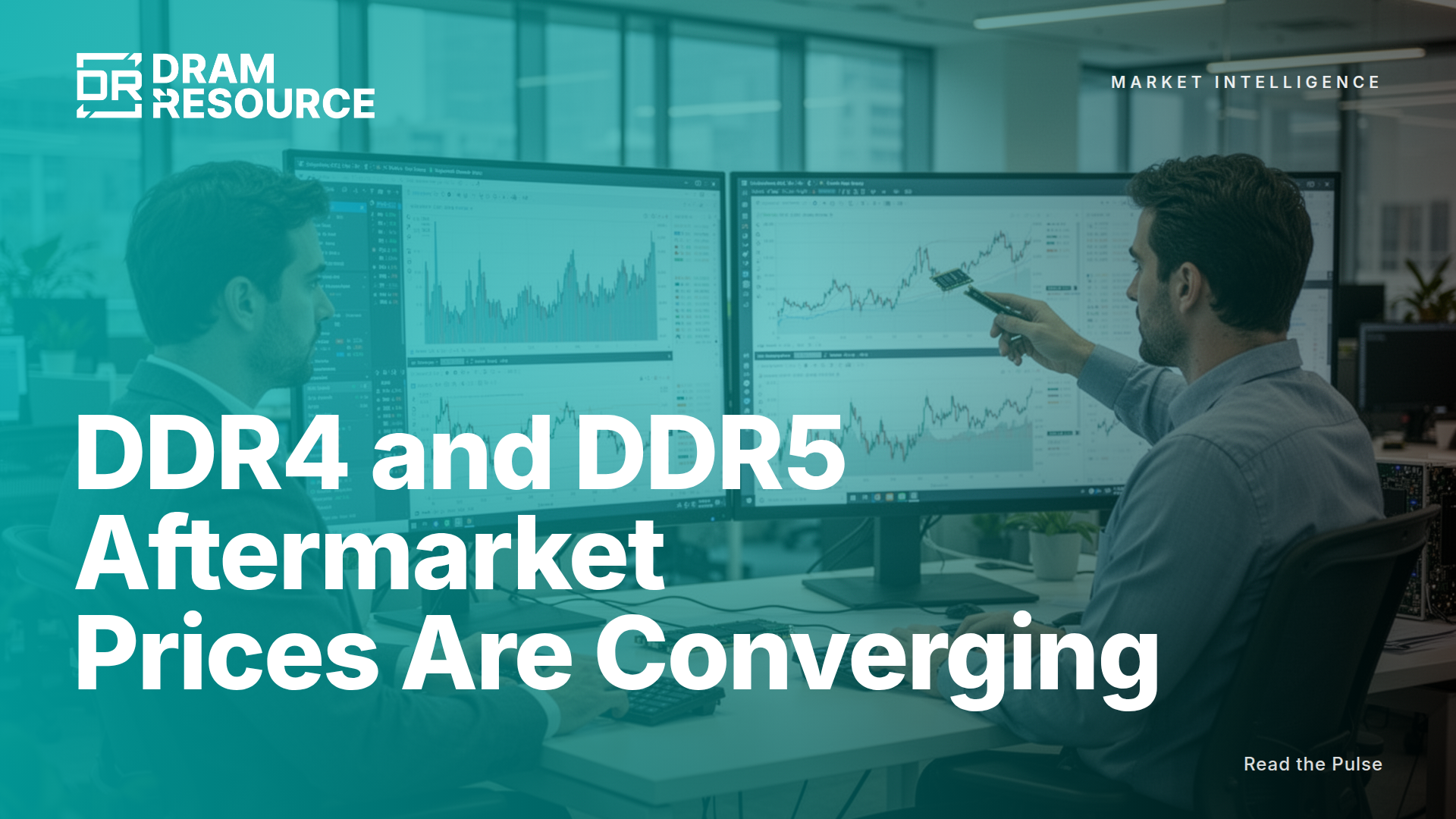
The Pulse Reads DDR4 and DDR5 Aftermarket Converging on Price
By DRAM Resource Editorial Staff
Secondary-Market Signal: The Spread Is Closing
Recent DRAM Market Pulse readings are surfacing a pattern that matters for secondary-market buyers and ITAD operators: on select mid-range capacities — particularly 16 GB and 32 GB modules — DDR4 aftermarket pricing has been moving upward while DDR5 aftermarket pricing drifts lower. The spread between the two generations in the secondary channel is compressing.
This is not noise. The convergence is visible across multiple data pulls and is most pronounced in the 16 GB DDR4-3200 versus DDR5-4800 comparison, where the aftermarket differential has narrowed to low single-digit percentage points on a per-module basis.
Spot-New vs. Aftermarket: Two Different Stories
The spot-new market still carries a meaningful DDR5 premium. New DDR5 production remains constrained relative to DDR4, and OEM contract pricing reflects generational transition costs. But the aftermarket operates on different fundamentals.
Secondary supply of DDR5 is growing as the installed base of DDR5 platforms — primarily Intel 12th/13th/14th-generation server and workstation deployments — matures and enters the ITAD cycle. At the same time, DDR4 secondary supply has been abundant for several quarters, which has kept aftermarket DDR4 prices from rising as quickly as some recyclers anticipated.
The result: buyers sourcing from the secondary market face a pricing environment where DDR4 and DDR5 are functionally cost-equivalent on capacity bands where platform compatibility overlaps.
What Convergence Signals for Sourcing Decisions
For corporate buyers and procurement teams, convergence changes the calculus. When aftermarket DDR5 reaches price parity with DDR4, platform-upgrade decisions previously deferred on cost grounds become more defensible. A sourcing desk anchoring DDR4 as the default value option needs to revisit that assumption for the capacities where the spread has closed.
For ITAD operators and recyclers, convergence is a margin signal. The window during which DDR4 carries a secondary-market premium over DDR5 — purely on scarcity dynamics — is narrowing. Operators holding significant DDR4 inventory should be monitoring Pulse data closely rather than assuming the DDR4 premium persists through year-end.
The spread between bulk commodity rates and current aftermarket pricing remains the key value metric. Operators who aggregate and grade DRAM at module-level market value rather than bulk weight recover substantially more per unit. Convergence does not eliminate that spread; it changes which generation is undervalued.
How to Read the Convergence in Real Time
The DRAM Market Pulse tool tracks DDR4 and DDR5 aftermarket pricing across capacity bands on a rolling basis. The convergence pattern described here is visible in the tool's generation-comparison view. Buyers and operators can use it to set procurement benchmarks, evaluate secondary-market bids, and time disposition decisions against live data rather than lagging list prices.
For structured market commentary alongside the raw signal, the DRAM Pulse Report provides forward-looking capacity analysis updated alongside the tool. Broader context on supply-chain developments feeding into secondary-market dynamics is tracked in DRAM Industry News.
Sourcing Takeaway
Treating DDR4 and DDR5 as categorically different price tiers in secondary-market sourcing is now a dated assumption for several capacity points. The aftermarket is not organized by generation; it is organized by supply, demand, and platform compatibility. Procurement desks and ITAD operators who anchor to generation as a proxy for price will increasingly mis-price inventory and bids as convergence deepens.
Watch the spread. The Pulse is reading it in real time.
References
- DRAM Market Pulse Tool — https://dramresource.com/dram-pulse/dram-market-pulse-tool
- DRAM Pulse Report — https://dramresource.com/dram-pulse/report
- DRAM Resource Industry Analysis — https://dramresource.com/industry-analysis
Questions or comments? We'd love to hear from you — reach the editorial team at info@dramresource.com.