
When New Memory Doubles, the Aftermarket Becomes a Supply Line — Not a Discount
By DRAM Resource Editorial Staff
For years, secondary-market DRAM carried a single narrative: it was cheaper than new. Procurement teams bought it when budgets were tight, not when supply was tight. That framing no longer holds.
The Contract Surge Changes the Equation
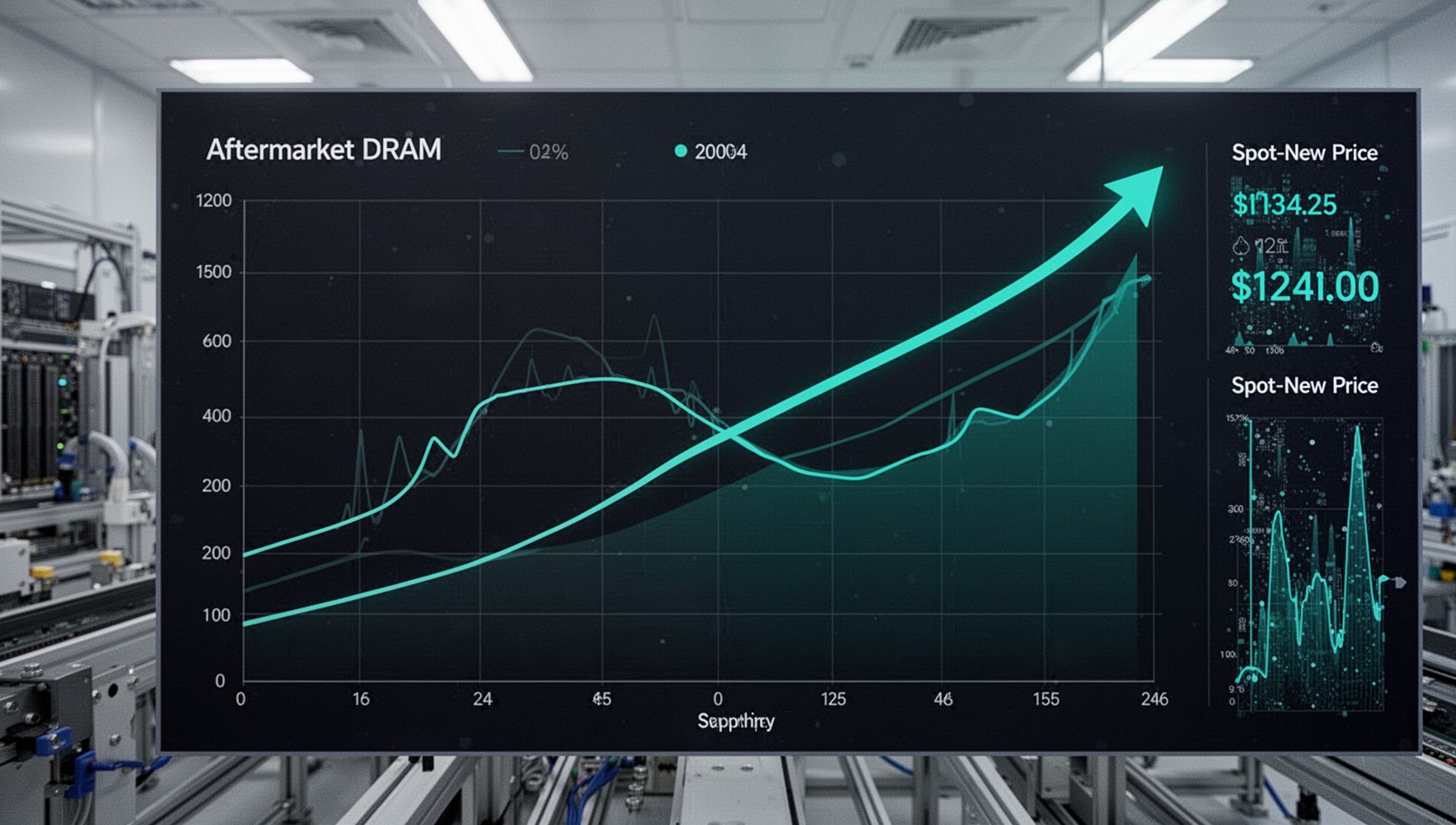
DRAM and NAND contract prices are climbing again — Q2 projections point upward across virtually every density tier. Spot-new quotes for server-grade DDR4 and DDR5 have surged well into triple-digit percentage increases over their recent lows, driven by tightened fab output, recovering hyperscaler demand, and inventory drawdowns that left channel buffers thin. When the cost of new reaches those levels, the aftermarket stops being a discount category. It becomes an alternative supply line.
This is not a semantic shift. It has structural implications for how corporate buyers, ITAD operators, and data-center procurement teams should model their sourcing mix.
What the Pulse Readings Show
The DRAM Resource bi-weekly Pulse Report tracks aftermarket spreads against spot-new benchmarks across RDIMM and UDIMM form factors. The current readings tell a clear story: aftermarket-to-new spreads have compressed sharply at higher densities. 32GB DDR4 RDIMMs — the workhorse of midcycle server refresh programs — are trading in the aftermarket at spreads that would have seemed unremarkable twelve months ago but now represent meaningful cost relief versus new-spot equivalents.
Per-GB reads reinforce this. At current new-spot pricing, secondary DDR4 server memory is delivering acquisition cost efficiency that justifies placing it not at the margin of a procurement strategy, but at the center of a tiered supply plan.
UDIMM spreads tell a slightly different story. Workstation and edge-compute demand has absorbed more of the secondary pool at those densities, tightening aftermarket availability relative to RDIMMs. Buyers sourcing for homogeneous fleets of workstations should expect less arbitrage runway than server-memory buyers — but secondary still outperforms new in most U-grade configurations at this point in the cycle.
The Aftermarket as a Strategic Instrument
What changes when secondary becomes a supply line rather than a discount? The procurement calculus shifts in three ways.
First, sourcing lead times matter more. A discount purchase can wait for the right lot. A supply-line purchase requires forecasting, vendor qualification, and SKU-level visibility — the same disciplines that govern new-channel procurement.
Second, grade fidelity becomes non-negotiable. When secondary DRAM is filling production slots rather than supplementing tested capacity, buyers need assurance that refurbishment and test standards are documented and auditable. Grade opacity is a discount-channel problem. It cannot survive in a supply-line context.
Third, market intelligence becomes a recurring operational input, not an occasional reference. Secondary pricing moves fast. The spread advantage visible in this week's Pulse data may not exist in the same form six weeks from now if new-spot softens or aftermarket pools tighten at a particular density. Buyers who are checking pricing quarterly are flying blind.
The Pulse Report as Your Instrument Panel
DRAM Resource's bi-weekly Pulse Report was built for exactly this environment. It provides RDIMM and UDIMM aftermarket spread data, per-GB benchmarks across key density tiers, and supply-side context — all updated on a two-week cadence that tracks the secondary market's actual velocity.
When new memory doubles, the aftermarket does not merely become more attractive. It becomes load-bearing. The Pulse Report is how you fly it with instruments, not by feel.
References
- DRAM and NAND Contract Prices to Climb Again in Q2 — https://www.tomshardware.com/pc-components/dram/dram-and-nand-contract-prices-to-climb-again-in-q2
Questions or comments? We'd love to hear from you — reach the editorial team at info@dramresource.com.